
Checking Criminal History in Kansas City
Start with the kind of Kansas City record, not just the person's name. A KCPD incident or arrest report comes from the police custodian. An ordinance case belongs to Kansas City Municipal Court. A state felony or misdemeanor filed in Jackson County belongs to Missouri's 16th Judicial Circuit and appears in Case.net when public. Current detention information comes from the agency or facility that has custody.
- Identify whether KCPD, another police agency, or a federal agency created the event.
- Request the police record by CRN, date, place, event type, and a clear description.
- Check Kansas City Municipal Court when the charge is a city ordinance matter.
- Search Case.net and the 16th Circuit for a filed state felony or misdemeanor.
- Use the current holding agency for custody, then MSHP only when a statewide identity-based history is needed.
This route avoids a common Kansas City mistake. A county occupant entry is not KCPD's report, while a KCPD report does not establish the final court outcome. The broader Jackson County criminal records overview provides countywide detail once the local channel has been checked.
Kansas City Police Report Numbers
KCPD calls its key report identifier the CRN. The department's General Public Records Request asks for that number when known, plus the incident date, time, location, event type, and a description. Supplying a CRN is the fastest way to point staff toward one Kansas City event, but a request can still be made with enough other facts to identify the record.
The form separates ordinary records from audio and video. State exactly what is sought. A narrative report, a specific recording, and a broad set of media can require different review. Describe the event in plain terms and include a useful date range rather than asking for every record tied to a common name. KCPD may need more facts or proof of relationship before it can decide which parts are open.
Note: Keep the submitted form and CRN together because later Kansas City court and police contacts may use different case identifiers.
Kansas City Police Department Records
The Kansas City Police Department is the creator and custodian for police incidents its officers handle. Its records route covers reports and related media subject to the Missouri Sunshine Law and other access limits. Headquarters is at 1125 Locust Street, Kansas City, Missouri. The general department number is 816-234-5000. A requester should use the current instructions from KCPD Records rather than sending the request to the county clerk or detention center.
KCPD Records
1125 Locust Street
Kansas City, MO
816-234-5000
Use the General Public Records Request for a described incident, report, or requested media.
The official KCPD site also provides a useful view of the department whose records are being requested.
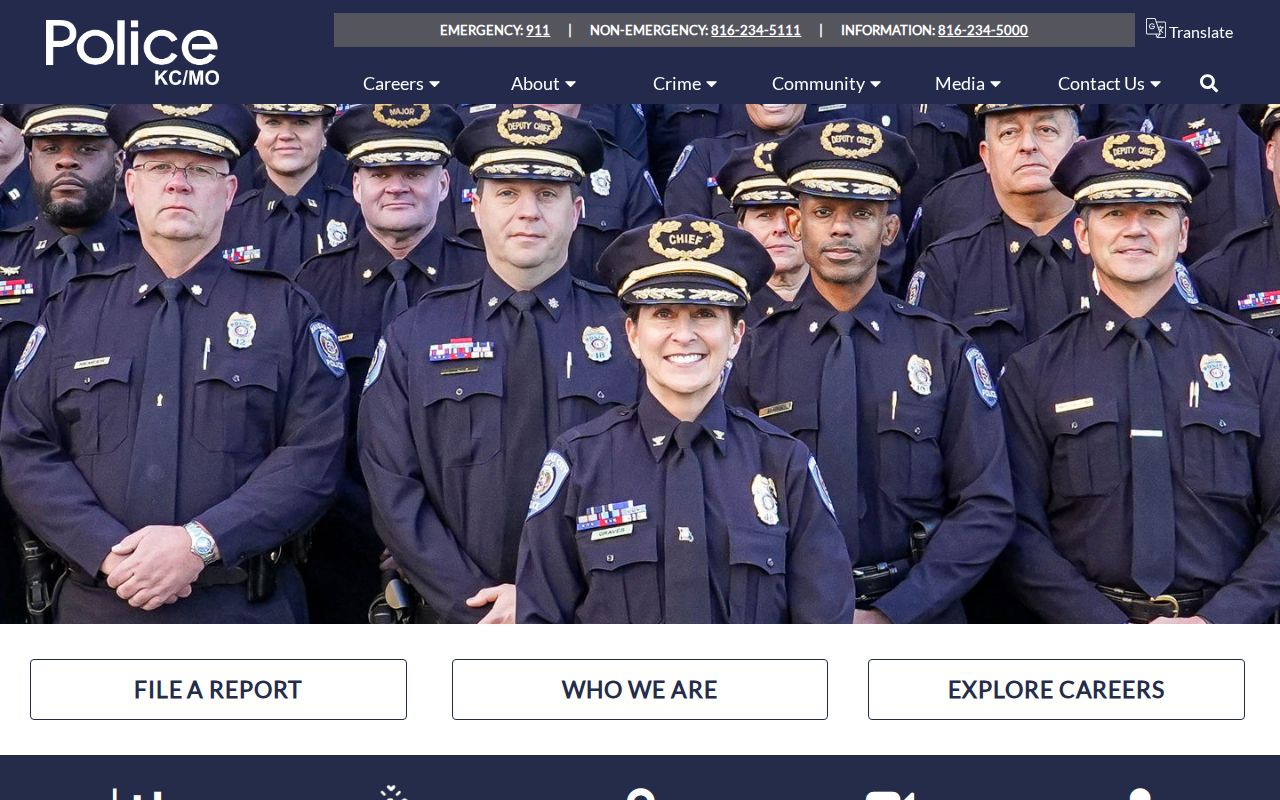
The KCPD image grounds the records process in the city agency that creates the underlying police file, not in the court or county jail.
Kansas City Record Access Relationships
Two people can ask for the same Kansas City police event and receive different open portions. KCPD's form asks why the requester has an interest because Missouri law gives some people access that the general public does not have. The form includes current civil litigation, a current municipal case, a possible civil claim or defense, certain next-of-kin ties, and whether the requester is seen or heard in mobile video.
- CRN
- The KCPD event or report number used to identify the police file.
- Relationship
- The requester's legal or factual connection to the event or person in the record.
- Mobile video interest
- A statement that the requester is depicted or heard in the requested recording.
- Proof of relationship
- Documents KCPD may request before releasing material available only to a defined person.
Answer those questions accurately and attach proof when the form calls for it. The questions are not filler. They help the custodian apply the Sunshine Law, investigative-record rules, privacy protections, and any access right tied to a case or family relationship.
Kansas City Arrests and Bookings
A Kansas City arrest may lead to several records held by different offices. KCPD creates its incident or arrest report. The intake agency records custody and processing facts. A prosecutor may later file a different charge, fewer charges, or no charge. The court then creates a docket, bond entries, hearings, and a disposition. Each part needs its own check.
Kansas City arrestees can appear in Jackson County custody, a contract or municipal facility, federal custody, or state custody. The Jackson County occupant search is useful only for selected current county detention information. The county expressly says that its operational data is not an arrest report, court record, or booking record. If the person does not appear, identify the arresting agency, call the likely holding facility, and check for a filed case.
For more county custody routes, use the Jackson County arrest lookup. Keep Kansas City altitude in mind: KCPD remains the source for the report it created even after a transfer.
Missing Kansas City Custody Records
A blank county occupant result does not prove that no Kansas City arrest occurred. The person may have been released, moved to another facility, processed by a municipal or contract unit, held federally, or not yet visible after an arrest. Name spelling and portal lag can also affect a search. The right response is to follow the event rather than repeat the same county search.
First call the arresting agency and ask where the person was taken. Next check the named facility's current-custody channel. Search Case.net for a public state case after allowing time for filing. If a federal agency made the arrest, use the federal court and custody systems instead of the county portal. Request the KCPD report when the arresting officer was with Kansas City police.
Note: Current custody, police allegations, and filed charges can change on different schedules and should be read as separate Kansas City records.
Municipal Court Records in Kansas City
Kansas City Municipal Court handles city ordinance cases. Its record is not the same as a state felony or misdemeanor docket in the 16th Circuit. The court is at 511 E. 11th Street, Kansas City, Missouri 64106, and its published telephone number is 816-513-2700. Use the municipal channel when the ticket, summons, or charge cites a Kansas City ordinance.
| Court Name | Kansas City Municipal Court |
|---|---|
| Case Types Heard | Kansas City ordinance matters and eligible municipal violations |
| Case Lookup Channel | Municipal Court's official online and clerk channels |
| What the File Shows | Case or ticket identity, charge, court date, status, disposition, and financial entries when public |
| State-Case Alternative | Missouri Case.net and the 16th Judicial Circuit for filed state charges |
Read the issuing authority on the document before choosing a court. A Kansas City address alone does not make a charge municipal. State charges arising inside the city move through Jackson County's circuit court, while some federal matters move through the U.S. District Court.
Two Kansas City Criminal Courts
The charge source is the practical dividing line. A city ordinance citation belongs to Municipal Court. A prosecutor-filed Missouri felony or misdemeanor belongs to the 16th Circuit. A single event can touch both systems if different legal issues arise, so search both when the papers or agency referral do not make the filing authority clear.
| Record Point | Municipal Court | 16th Circuit |
|---|---|---|
| Legal authority | Kansas City ordinance | Missouri criminal statute |
| Main search | City court channel | Case.net, limited to Jackson County |
| Physical counter | 511 E. 11th Street | Criminal Records at 1315 Locust Street for Kansas City cases |
| Typical file | Ticket, ordinance charge, hearing, disposition, payment | Complaint or information, motions, plea or trial, judgment, sentence |
For the state side, Missouri Case.net can be searched by litigant name or case number. Narrow the court to Jackson County or the 16th Circuit. Compare the full name and case context before opening a record, then read each charge and disposition separately.
Where Kansas City Records Go
Kansas City police records begin with KCPD, but the later state case does not remain inside the police file. Officers refer facts and evidence for prosecutorial review. If a Missouri charge is filed, the 16th Circuit creates the court case. The court's disposition and other reportable events then flow to the Missouri State Highway Patrol Central Repository under state reporting law.
Record flow: Kansas City Police Department › Jackson County Prosecuting Attorney and 16th Circuit › Missouri State Highway Patrol CJIS Central Repository
A recent Kansas City event is usually clearest at KCPD. A filed charge and outcome are clearest in Case.net and the court file. A statewide, identity-based open-record result comes from MACHS. That sequence explains why an early police allegation can differ from the charge a prosecutor files and why the final court disposition may appear later in the state history.
Kansas City Records Beyond Downtown
Several major record offices cluster in downtown Kansas City. KCPD headquarters is at 1125 Locust, the state criminal-record counter for Kansas City cases is at 1315 Locust, Municipal Court is at 511 E. 11th, and the county courthouse and prosecutor are nearby. Those short distances can make it seem that custody records also belong downtown.
That assumption is now unsafe. Jackson County opened its replacement detention center at 7000 E. U.S. Highway 40 in 2026. Current custody can therefore sit well east of the downtown report and court counters. Call the facility before visiting or mailing. Use the police office for a KCPD report, the correct court for the case, and the current detention instructions for a person in custody.
This split is a useful Kansas City record map: creation, adjudication, and custody may each have a different physical address. One trip to Locust Street cannot answer every record question.
Public Access Rules in Kansas City
Kansas City agencies apply the Missouri Sunshine Law alongside more specific criminal-record and court rules. The public policy favors open records, but active investigative material, juvenile files, sealed cases, protected identities, and confidential personal data can be withheld. A public docket entry also does not make every attached police file or court document public.
Key Statutes:
Section 610.011 RSMo states Missouri's policy for construing the Sunshine Law in favor of openness.
Section 43.503 RSMo governs reporting of criminal-history events to the state Central Repository.
Section 43.506 RSMo identifies reportable offenses and repository information.
Ask for a defined Kansas City record and expect the custodian to review it. If a portion is closed, the open part may still be released with redactions. Court access follows court rules, including limits on remote documents and sealed files. A requester who is a party to a sealed 16th Circuit case may need to appear with photo identification.
Kansas City Audio and Video Records
KCPD's request form warns that research and review for audio or video can add more than three weeks. That is not a promised completion date. Recordings may require staff to locate files, check the requester's relationship, review content frame by frame, and protect material that cannot be released. A request for all media tied to a broad event can take more work than a narrow request for one known clip.
Use the CRN, date, time, location, event type, and a precise description. State whether audio, video, or both are sought. If the requester appears or is heard in the file, answer that form question and provide any needed proof. Keep an ordinary report request distinct when the written narrative is also needed.
A delay in media review does not mean the related Kansas City court file is delayed. Municipal Court and the 16th Circuit manage their own dockets. Check the correct court separately for hearings, charges, and outcomes.